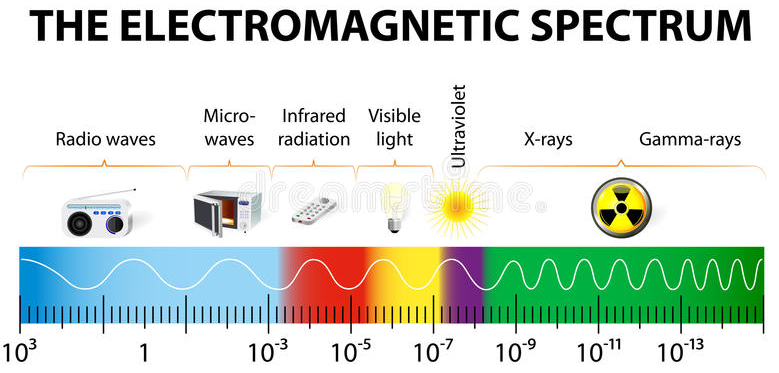
Infrared radiation is invisible to us. What I mean by that is that it can’t be seen by the unaided human eye. Infrared cameras, through the use of special lenses, filters, and processing, allow us the ability to see inside the “infrared spectrum”. Just like visible light, infrared radiation resides on what is called the electromagnetic spectrum. Visible light (what we can see with our eyes) is actually a very small part in the middle of the known electromagnetic spectrum. Infrared radiation lies just below (longer wavelength) visible light on the spectrum shown below.
About now, you may be asking yourself why it’s necessary to see inside the infrared spectrum and more specifically, why it could benefit you to see infrared radiation. Infrared radiation is an invisible form of energy that is very specific to the transfer, reflection, and emission of heat energy. When we think of heat, we generally think of a feeling we receive by touching something that is hot. There is an obvious hazard to finding out something is hot by touching it! An infrared camera can be used to determine when an object is hot without having to touch the object. It can also be used to indicate temperature differences between objects, and show heat attenuation when an object is hot in one spot but it cools as the distance increases away from the source. Using some of the characteristics I just mentioned, an infrared camera can be used for inspection and detection of many issues across many applications, such as mechanical, electrical, building inspections, and even medical.
The Electromagnetic Spectrum was discovered in pieces. The Electromagnetic Spectrum as we know it, was built over a long period of time by many great minds.


 Hands-on Reliability